


Syllabus: GS2/ International Relations, GS3/ Internal Security
Context
- The recent response of the Indian Navy to piracy attempts in the Gulf of Aden brings the issue of maritime piracy to fore.
What is Maritime Piracy?
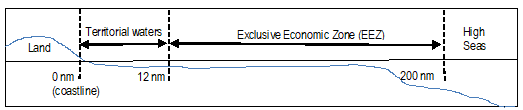
- The 1982 United Nations Convention on the Law of the Sea (UNCLOS) defines piracy to include any acts of violence, detention or destruction committed for private ends against persons or property on board a ship on the high seas or outside the jurisdiction of any state.
- Though, the Piracy differs from armed robbery at sea which occurs within a country’s territorial waters and falls under the jurisdiction of the coastal State.
Reasons of Maritime Piracy
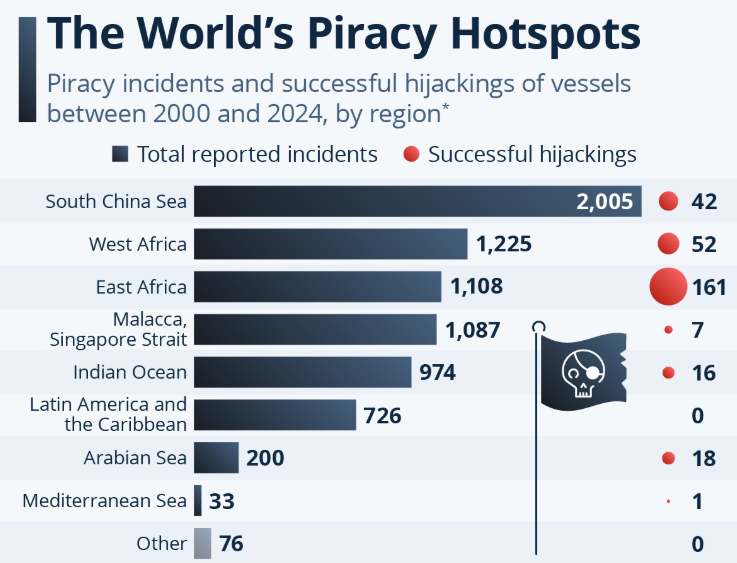
- Land-Based Socio-Economic Drivers: Poverty, unemployment, livelihood insecurity and declining marine resources drive coastal communities towards piracy as an alternative source of income.
- Political and Governance Failures: Political instability, corruption, and inadequate maritime law enforcement create conditions that enable piracy to flourish.
- Geographic and Traffic Vulnerabilities: Busy international shipping routes, strategic chokepoints & vast maritime areas with limited surveillance provide attractive and accessible targets for pirates.
- Transnational Organized Crime: Well-organized criminal networks facilitate piracy by providing financing, logistics, weapons, intelligence and links with other illicit activities such as smuggling and human trafficking.
Importance of Maritime Security for India
- Nearly 95% of India’s trade by volume and around 70% by value is carried through maritime transport.
- Also more than 80% of India’s crude oil imports are transported through sea routes.
- India has a coastline of over 11,098 km, an Exclusive Economic Zone (EEZ) of about 2.37 million sq. km, and island territories located near critical sea lanes.
- Secure maritime routes are necessary for India’s trade, energy security, blue economy, and strategic interests in the Indian Ocean Region.
India’s Maritime Security Architecture
- Role of Indian Navy: Since 2008, Indian Navy has deployed units in the Gulf of Aden and East coast of Africa towards antipiracy patrols.
- Bilateral/multilateral maritime exercises, Joint Exclusive Economic Zone (EEZ) surveillance, Coordinated Patrols (CORPATs) with Friendly Foreign Countries are being undertaken by the Navy.
- National Maritime Domain Awareness (NMDA) integrates information from multiple agencies for real-time monitoring of maritime activities.
- The Government of India has established the Information Fusion Centre-Indian Ocean Region (IFC-IOR) which has linkages with 25 partner nations and over 40 international multinational organisations for real-time information exchange towards enhancing maritime security.
- Indian Coast Guard is responsible for coastal security, search and rescue, pollution response, and anti-smuggling operations within India’s maritime zones.
Government Initiatives
- Maritime Anti-Piracy Act, 2022: It provides a legal framework to prosecute pirates regardless of nationality. The Indian authorities can seize pirate ships and prosecute offences committed on the high seas.
- Security and Growth for All in the Region (SAGAR): It promotes regional cooperation, maritime security, and capacity building in the Indian Ocean.
- Indo-Pacific Oceans Initiative: It leads to collaboration on maritime security, disaster risk reduction, and sustainable use of marine resources.
International Initiatives
- UNCLOS (United Nations Convention on the Law of the Sea): Provides the legal definition of piracy and allows states to seize pirate ships and arrest crews on the high seas.
- IMO (International Maritime Organization): Develops global regulations to manage maritime threats and secure global trade.
- Djibouti Code of Conduct: Regional framework for combating piracy in the Western Indian Ocean.
- Regional Cooperation Agreement on Combating Piracy and Armed Robbery against Ships in Asia (ReCAAP): Formalised in 2004, it is the first and only regional government-to-government agreement to promote and enhance cooperation to suppress piracy and armed robbery against ships in Asia.
What are the Challenges?
- Vast maritime areas make continuous surveillance and rapid response to maritime threats difficult.
- Emerging use of drones and advanced technologies by pirates and criminal groups has made maritime crimes more sophisticated.
- Coordination among multiple national agencies and international jurisdictions becomes challenging due to overlapping mandates and legal complexities.
- Rising geopolitical rivalries and regional conflicts increase maritime insecurity.
Gulf of Aden
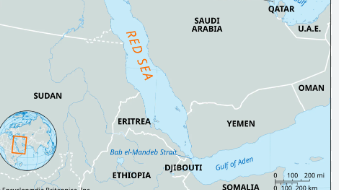
- It is a deepwater gulf located between Yemen on the Arabian Peninsula and Somalia in the Horn of Africa.
- It connects the Arabian Sea to the Red Sea through the Bab el-Mandeb Strait.
Geographical limit of different maritime zones
Previous article
News In Short 02-07-2026
